פורסם עם: General Aviation

H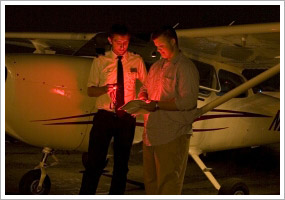 ot night spots
What’s a good destination for a night dual cross-country? The Federal Aviation Regulations get you part way to an answer, setting forth night flying requirements for private pilot applicants, including the mandate that your logged night cross-country flight be “of over 100 nautical miles total distance.” But why not make your destination a practical choice? Is there an airport that you’d expect to visit at night after earning your pilot certificate? If so, check it out during training, in your instructor’s company.
Your CFI will ask you to research the airport and discuss its suitability as a nocturnal destination. Check on its runway lighting, fuel availability, and whether it has amenities such as visual approach guidance systems. Read more about airport infrastructure, the subject of the Nov. 28, "Training Tip."
If your destination is an airport you’ve used in daylight, don’t assume that a night flight will employ the same route and navigation plan. A higher altitude to clear any difficult-to-see obstructions may be prudent. Navigation may be altogether different at night. “Though you navigate by pilotage during the day, you may want to rethink your strategy at night. Because the terrain can look unfamiliar and desolate at night, it's easy to find yourself off course (or, at least, beginning to question your true position). To avoid this, back up your pilotage with radio navigation. Select the VORs or NDBs (nondirectional beacons) that will guide you to your destination,” wrote Robert N. Rossier in his feature on night flight available on the AO! PA Flight Training Web site.
Often, problems that arise on night flights trace back to lack of preparation or rushing through preflight details (such as passing up the opportunity to refuel). Compound that error with unforecast bad weather, or systems failure in flight, and now you are facing serious difficulties, as the cautionary tale “Never Again: A cold night in February” makes clear. But make a good go/no-go decision and fly with a healthy surplus of fuel aboard, and you’ll pay a visit to one of general aviation’s most thrilling realms: the beautiful, frequently serene night skies. David Montoya wrote about this in his October 2002 AOPA Flight Training feature “The after! -hours club."