פורסם עם: General Aviation

SPEAKING THE NUMBERS
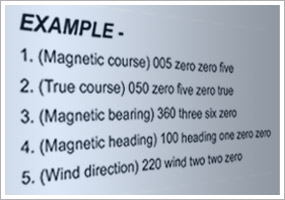
As you depart on a solo cross-country, you are requested by air traffic control to "say your on-course heading." During preflight planning you calculated a compass heading 10 degrees east of north for your cruise leg. How should you communicate that information in your response to the controller?
Aviation radio technique is full of procedural nuances, as student pilots quickly learn. There's the phonetic alphabet to memorize, and figures are rendered in specific formats for critical values such as altitudes, radio frequencies, and directions. It's not safe to communicate casually over an ATC frequency. Who and where you are, and your intentions, must be stated in clearest possible terms. That's why it's so important to identify your aircraft's call sign and location correctly on initial call-ups, and to make sure the controller knows that you understand and will comply with instructions received, as discussed in the Aug. 15 Training Tip on acknowledging ATC clearances.
Despite all that, courses and headings remain a common source of confusion for new pilots, especially if the pilot fails to use other safeguards against turning the wrong way. So, getting back to our opening scenario, a pilot using proper radio technique will respond to the controller that he will be flying an on-course heading of "zero-one-zero degrees." See Chapter 4 of the Aeronautical Information Manual for other examples of communicating directions. The key is to always use three digits; north is spoken as "three-six-zero."
Sounds easy enough, but more than one pilot has begun the process of getting lost by turning, for example, to a heading of 220 degrees when the correct heading was 022 degrees. Avoid such errors by reviewing the general direction of your course line—north-northeast in the example given above—along with the specific numbers you will expect to see on your heading indicator. "Bug" the new heading at every course change as recommended in the Dec. 3, 2004, Training Tip as an additional safeguard against flying in the wrong direction.
Communicating directions in three digits may seem at first like a tedious procedural ritual—until the day comes when doing so saves you from a costly or dangerous error!
.